
Q2 in Review: PTAB Petitions Plummet as Top Courts Issue Dueling SEP Decisions
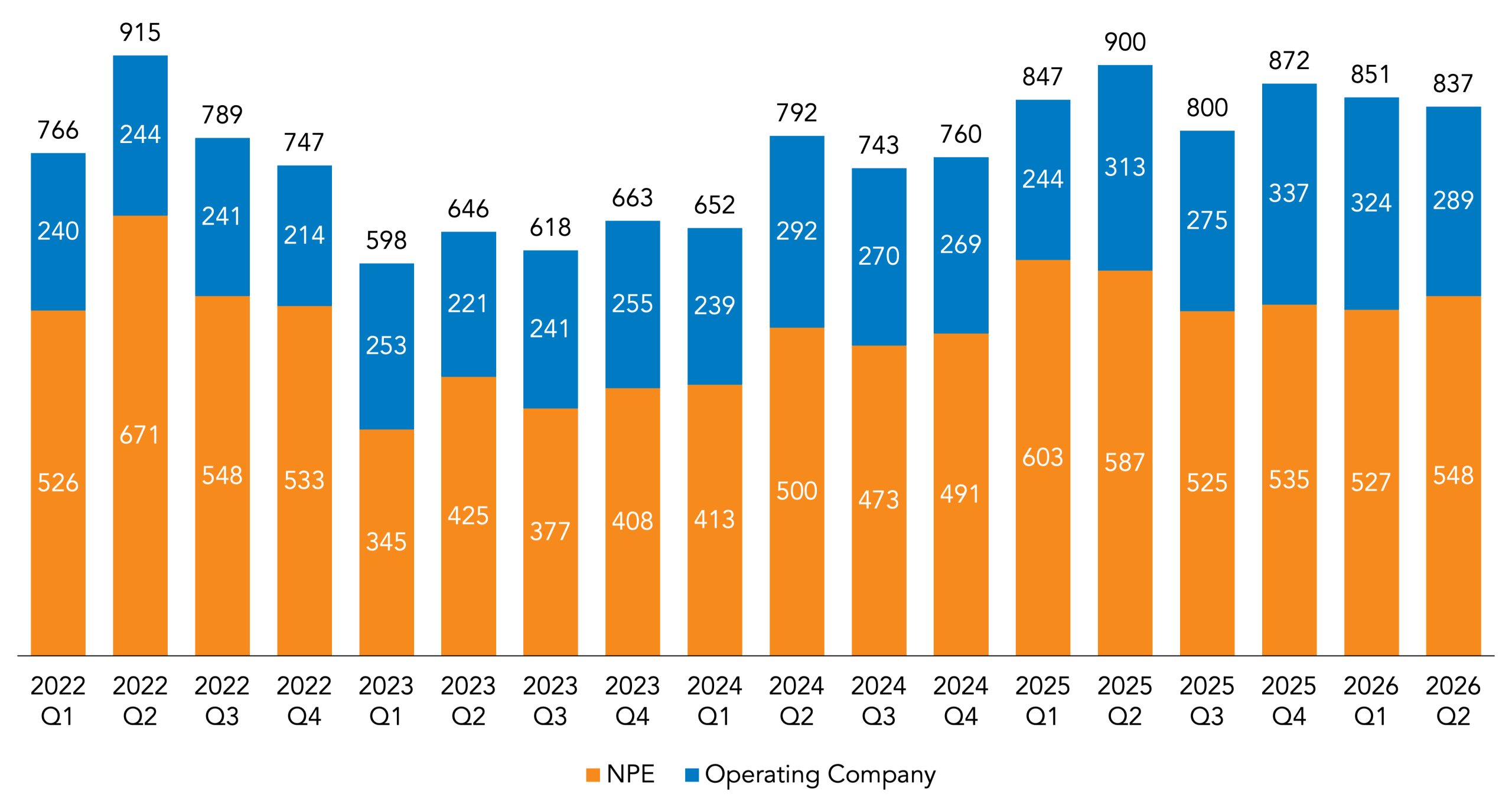
US patent litigation decreased by 7% in the second quarter of 2026, with NPE and operating company litigation each dipping by about that same percent.
USPTO Director John Squires also continued to reshape the Patent Trial and Appeal Board (PTAB) in Q2 through further changes limiting the availability of America Invents Act (AIA) review. These restrictions pushed new petitions down to a near-historic low, with the second quarter marking the Board’s lowest-ever full quarter—while ex parte reexaminations continued to rise. However, recent decisions by the Director could lead to new constraints on both procedures.
Meanwhile, the EU’s Unified Patent Court (UPC) detailed a new process for wielding the expansive long-arm jurisdiction that it gained through a landmark appellate ruling last year. Filing data reflect the court’s continued popularity, with the court’s German local divisions still seeing the bulk of new infringement suits.
Q2 also brought a series of notable standard essential patent (SEP) decisions from some of the world’s top venues, including one dispute that for the first time saw two courts issue competing decisions setting the terms of global licenses. A significant appellate ruling in the UK could also clear the way for more SEP disputes to be resolved through arbitration.
Momentum for third-party litigation funding (TPLF) disclosure and regulation also continues to build at both the state and federal levels. More than 30 states have either enacted or introduced TPLF-related legislation, including North Carolina, which in June became the first state to impose a broad ban on most forms of TPLF. At the federal level, lawmakers also introduced two patent-related bills in June aimed at addressing national security concerns. One would prevent certain foreign entities from obtaining or enforcing US patents, while a companion measure would require patent applicants to disclose ties to foreign adversaries.
RPX members are exclusively invited to join a live RPX Community webinar covering highlights from this report. Live sessions are scheduled to accommodate US, European, and APAC time zones starting on July 16 (US session). This webinar may be eligible for CLE credit in some states. See here to register or for more details.
Litigation Update: Patent Litigation Dips Slightly in Q2
NPEs added 548 defendants to patent litigation campaigns in Q2 2026, a decrease of 7% compared to Q2 2025 (when NPEs added 587 defendants). NPE litigation in the second quarter of 2026 exceeded the trailing Q2 average for 2023-2025 by 9% and was 4% higher than in the first quarter.
Meanwhile, operating company plaintiffs added 289 defendants this past quarter, an 8% decrease from Q2 2025. Litigation by operating companies beat the trailing Q2 2023-2025 average by 5% but was also 11% lower than in the first quarter.
| Defendants Added | Change Compared to: | ||||
| Q2 2026 | Q2 2025 | Q2 2023-2025 Average | Q1 2026 | ||
| NPE | 548 | -7% | 9% | 4% | |
| Operating Company | 289 | -8% | 5% | -11% | |
| Total | 837 | -7% | 7% | -2% | |
Overall, patent plaintiffs added 837 defendants in the second quarter of 2026, or 7% less than in Q2 2025 and 2% less than Q1 2026, also beating the trailing average by 7%.
Additionally, the operating company data above leave out another distinct category of litigation filed by a small group of design and utility patent owners targeting copycats and counterfeiters selling products online. RPX excludes such “e-seller” cases from analyses of district court litigation because they tend to follow a different dynamic compared to what one might consider the usual patent suit. These e-seller cases sometimes name hundreds of defendant entities, many of which may be merely online storefronts or aliases for the same ultimate parent. Also, plaintiffs primarily seek injunctive relief instead of damages, and their cases often end with the e-seller defendant’s failure to answer, followed by a default judgment.
This category of litigation is shown in grey below to illustrate its magnitude. As shown by the rightmost bar, e-seller litigation in Q2 2026 accounted for 851 defendants added, or 50% of all litigation during the quarter. As was also the case for the past three quarters, this represents a much lower volume of e-seller litigation than in recent quarters past.
Apart from the following graph, the other analyses in this report exclude pure design patent and e-seller litigation.
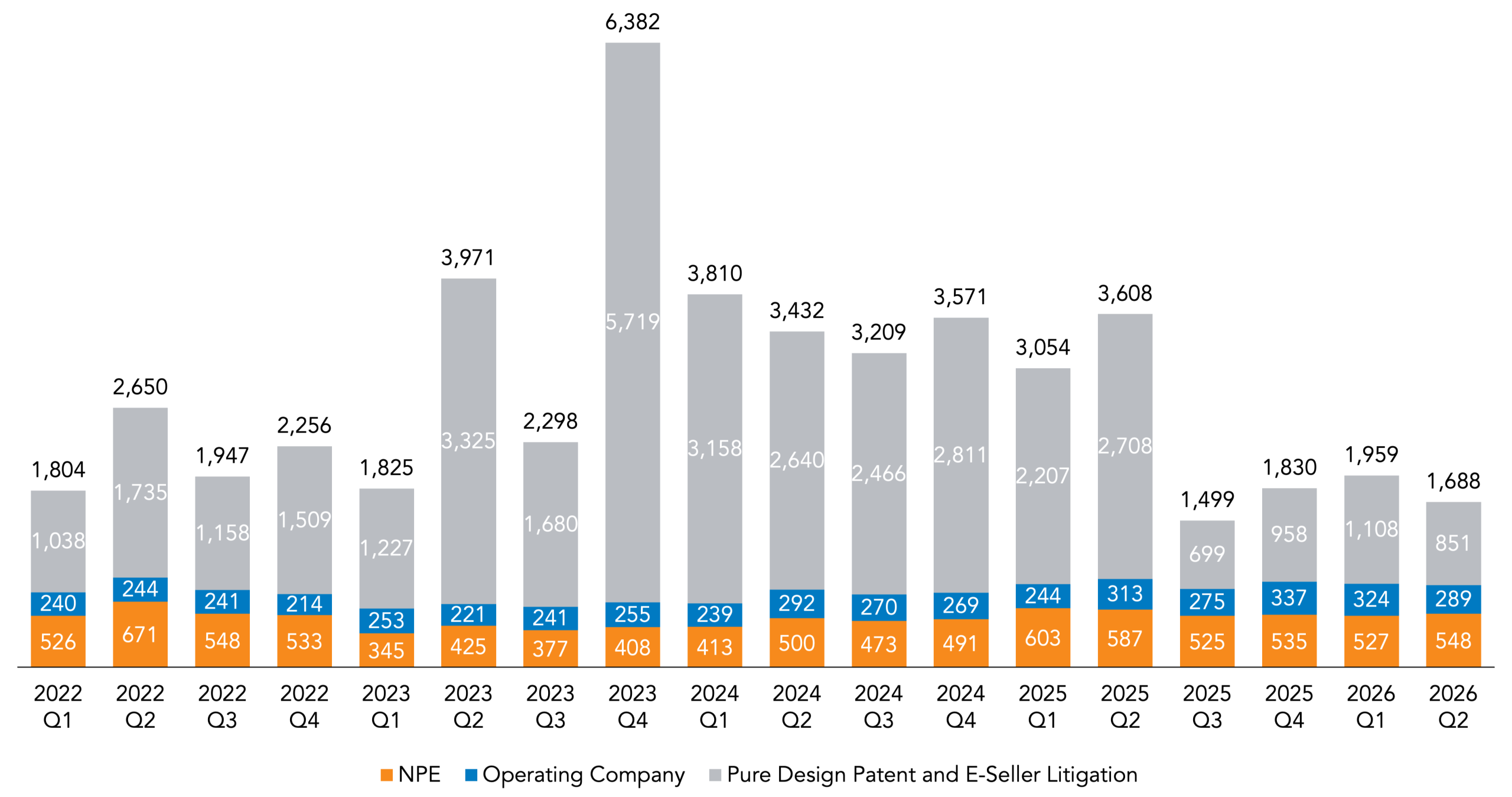
While the lower counts for the past four quarters are still subject to the caveat about defendants potentially having multiple online storefronts, as noted above, the decrease could also be related to efforts by some judges to apply stricter procedural rules to e-seller cases: As recounted in RPX’s Q1 in Review, these efforts include decisions and orders from judges in the Northern District of Illinois (urging plaintiffs to seek the relief described above through other means), the District of New Jersey (requiring more specific and plausible allegations of personal jurisdiction), and even the Eastern District of Texas (barring plaintiffs from seeking ex parte temporary restraining orders to freeze the assets of accused infringers for e-seller cases over utility patents).
The phenomenon of e-seller cases—also widely known as “Schedule A” actions, after the sealed exhibits used to identify defendant storefronts—has also come before the Federal Circuit as part of a broader appeal over design patent standards. The case at issue, Jacki Easlick v. CJ Emerald (24-1538), challenges the Federal Circuit’s Egyptian Goddess decision, which asks whether an “ordinary observer” familiar with the prior art would find an allegedly infringing design to be “substantially the same” as the patented design—here as applied in a preliminary injunction denial in an e-seller case.
In February 2025, a group of intellectual property scholars filed an amicus brief (see corrected version here) that both argues the injunction denial should be affirmed and also highlights the “legal and procedural deficiencies” in both this case and Schedule A litigation generally. The amici highlight what they characterize as the “abusive and legally flawed nature of Schedule A litigation, particularly in patent cases”: Such lawsuits “require judges to analyze extensive but vague allegations of infringement on an ex parte basis, and to do so quickly and at scale”, which the amici argue can be “especially harmful” when the result is to shut down storefronts and freeze “often-unrelated assets”.
The amici further contend that such cases are “rarely appealed” since the Schedule A model puts defendants at such an “extreme disadvantage”. As a result, they underscore that this case thus presents a “rare opportunity for this Court, in the course of evaluating the litigation and decision below, to address the abuses of the Schedule A litigation model in patent cases”.
Oral arguments were held in this appeal in March 2026.
Venue Update: East Texas Sees Top Verdicts as Judge Gilstrap Tackles NPE Injunctions
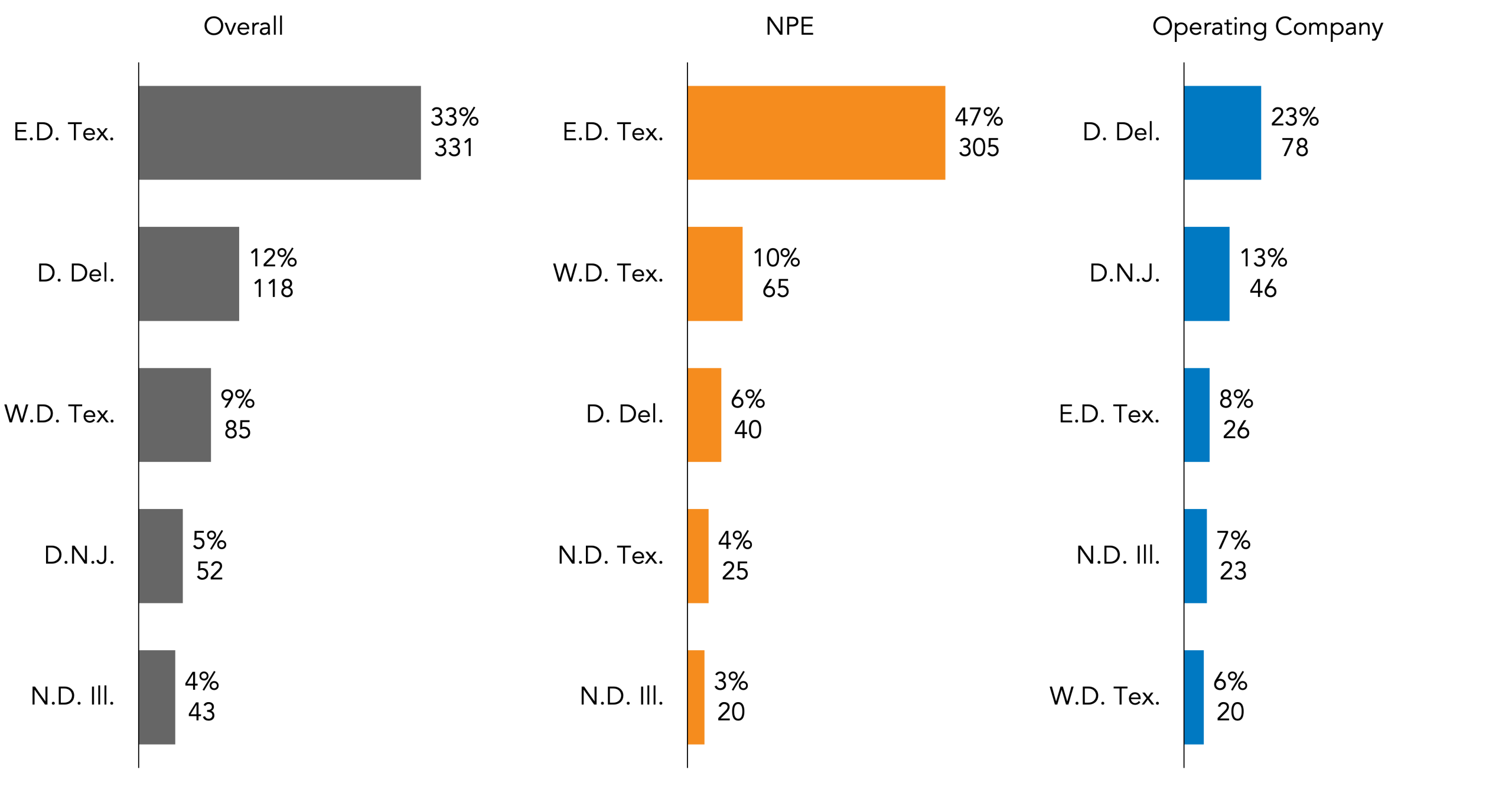
The Eastern District of Texas was the top patent district for overall litigation (i.e., with no filter for plaintiff type) and NPE litigation in Q2 2026, also holding the number-three spot for operating company litigation. In second for overall litigation was the District of Delaware, which held third place for NPE litigation but was the most popular district for operating company litigation. Meanwhile, the Western District of Texas trailed behind Delaware in third place for overall litigation and second for NPE litigation, taking fifth place for operating company filings.
Given the sheer volume of litigation being filed in East Texas, it is not a surprise that the district played host to some of the quarter’s most significant jury verdicts.
This included the quarter’s top damage award, returned on June 19 for funded plaintiff Aspen Networks, Inc.: The jury awarded $190M, finding the infringement of a single patent through the provision of Voice-over-Wi-Fi (VoWiFi) calling services by defendant Verizon (Verizon Wireless). Aspen’s cases against Verizon and fellow carriers AT&T (AT&T Mobility) and Deutsche Telekom (T-Mobile) were consolidated for pretrial purposes and then deconsolidated, on June 8, 2026, prior to trial as to Verizon. Trials will next be held against AT&T and T-Mobile, in that order, but those do not yet appear to have been scheduled.
Another plaintiff-side verdict came on April 16, when an Eastern District of Texas jury awarded $17M to Cyandia, Inc.—marking the third-largest damage award of the second quarter. The jury found one claim from each of two tried patents infringed by defendant SAP and not proven obvious. The award was characterized as a running royalty on the verdict form, and the jury also found the infringement to have been willful. Cyandia is one of six plaintiffs to have recorded a security interest in its patent holdings back in December 2023, each in favor of the same funding operation. A second plaintiff from that group, inventor-controlled VASU Holdings LLC, also won an infringement verdict on June 26, when an East Texas jury awarded it $3M after finding infringement by Samsung of one of three tried patents.
A fourth Q2 infringement verdict came down in East Texas as well: On May 22, a jury returned a verdict for SK Nexilis against Solus Advanced Materials and several Volta Energy Solutions entities, awarding $3.3M for the infringement of five patents generally related to battery copper foils. The parties compete to provide such foils for batteries in electric vehicles.
However, East Texas also saw some notable defense victories this past quarter. Among them was a noninfringement verdict for Cisco in the first case filed in the litigation campaign of EireOg Innovations Limited, an Atlantic IP Services Limited plaintiff. The jury also answered in the affirmative a question relevant to a “control theory” for a wider license defense, finding that Cisco had shown that the tried patent was controlled, licensable, or enforceable by Atlantic IP after the effective date of a certain license—a finding that echoes a similar one in the Western District of Texas cases between Fortress Investment Group LLC’s VLSI Technology LLC and Intel.
Another noteworthy defense win came not from a jury but instead from a bench trial: On April 22, District Judge Rodney Gilstrap ruled that “under the doctrine of implied waiver, [Headwater Research LLC] cannot enforce the asserted patents against” Verizon Wireless. The patents referenced are the two that a jury found willfully infringed last year, awarding Headwater $175M in damages. Per the court, “Verizon’s belief—that Headwater would not enforce patents it knew Verizon was infringing in 2017—was both reasonable and induced by Headwater’s conduct. Every law student, early on, learns the equitable concept of unclean hands”. Headwater has appealed that decision and the resulting final judgment in Verizon’s favor, while the defendant has cross-appealed the verdict and other decisions.
A more comprehensive overview of verdicts and defense wins in Q2 can be found here.
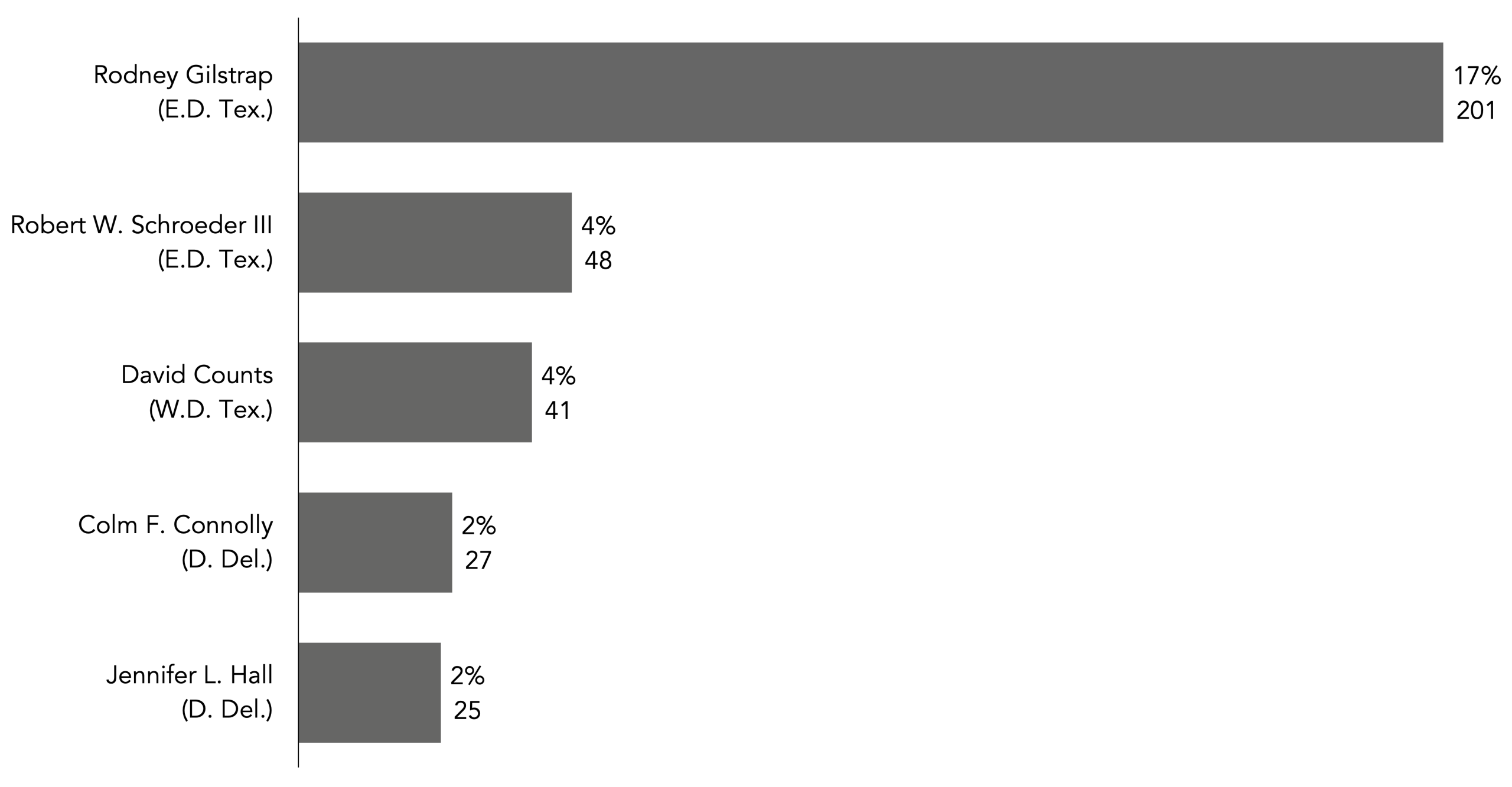
Meanwhile, Judge Gilstrap was once again the nation’s top patent judge, overseeing 17% of all new patent litigation in Q2. In addition to his ruling in the Headwater Research case, Judge Gilstrap also presided over the Aspen Networks trial discussed above.
Judge Gilstrap additionally issued a significant ruling this past quarter in a case in which the US government advocated for the availability of injunctive relief in NPE suits. In a statement of interest (SOI) filed in litigation from NPE plaintiff Collision Communications, Inc., which had sought a permanent injunction against Samsung, the US Department of Justice and the USPTO argued that such plaintiffs can establish the requisite “irreparable harm” under the US Supreme Court’s 2006 decision in eBay v. MercExchange because of the difficulty of valuing patents and calculating patent damages. On May 18, Judge Gilstrap found that that Collision had established irreparable harm—agreeing with the government as to valuation and damages, while rejecting the plaintiff’s attempt to establish a broader presumption of harm. However, Judge Gilstrap denied its request for an injunction, finding that the balance of hardships and the public interest, as also contemplated by eBay, weighed against the plaintiff.
Further background on this decision and related government SOIs on injunctive relief can be found here.
Market Sector Update: Inventor-Linked Plaintiffs, Familiar Monetization Firms and Individuals, and Even a University File E-Commerce and Software Litigation in Q2
The top market sector for NPE litigation in Q2 2026 was E-Commerce and Software, accounting for 31% of the defendants added to patent litigation campaigns during the quarter. Industrial saw the second highest amount of NPE litigation in Q2, followed by Consumer Electronics and PCs, Networking, and Semiconductors.
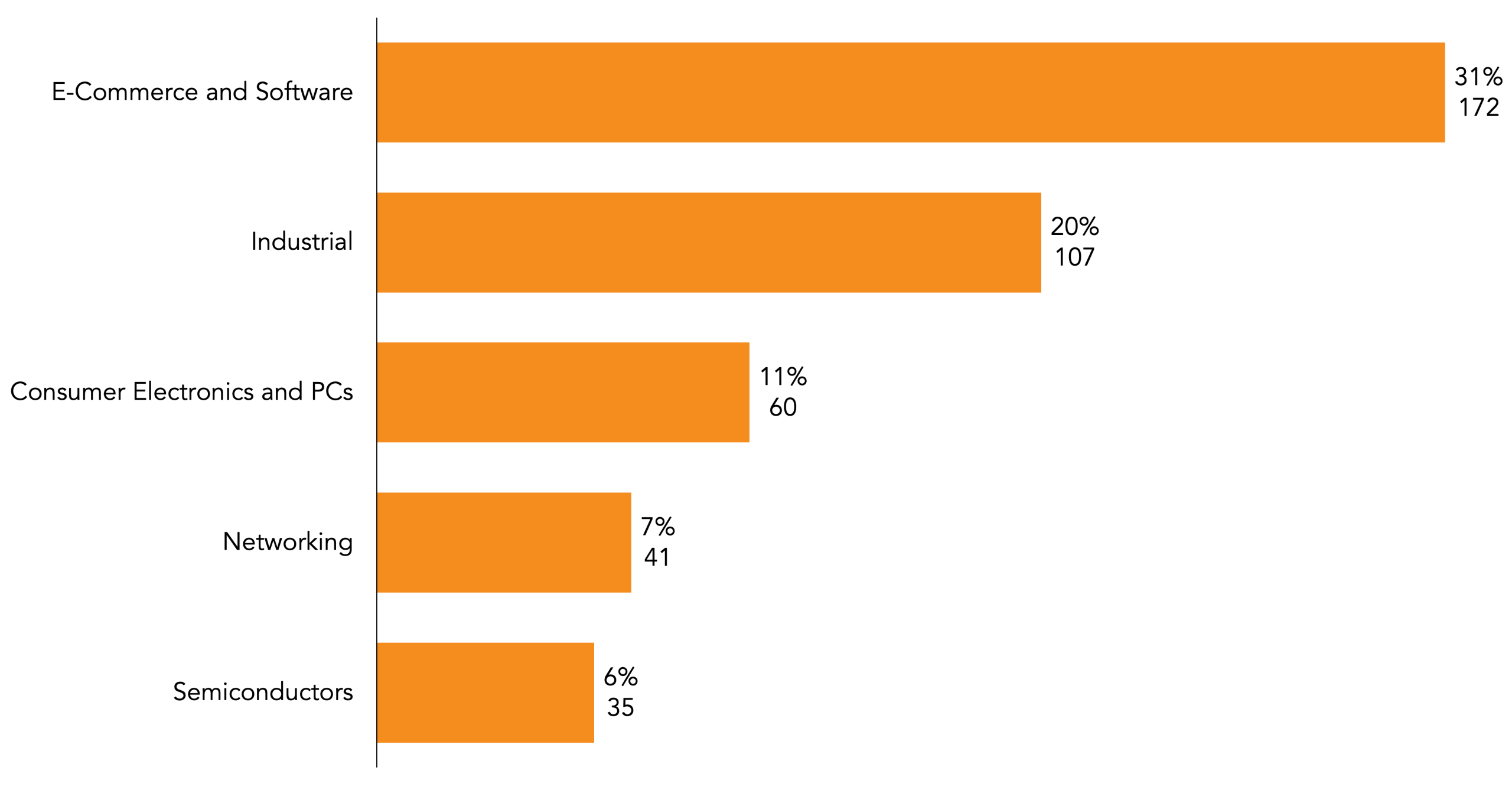
Among the NPEs hitting E-Commerce and Software in Q2 were a variety of inventor-controlled plaintiffs. For instance, BenedorTSE LLC added a new case to an ongoing campaign targeting mobile payment services in late May. Other mobile-centric cases from such plaintiffs included complaints from Aawaaz Inc., targeting mobile devices with integrated AI chatbots and other AI services in its first complaint in late May; IQX Corp., which filed its first two complaints over text message marketing systems in late May and late April; and TaskTime Texas LLC, which brought its inaugural complaint over mobile devices with task management software in late May as well.
Still more inventor-controlled litigants tagging this sector were Datascription LLC, which brought a single complaint in early May over social media services with automatic video transcription. Funded plaintiff Semantic Engines LLC also tagged the use of generative AI models in search processing systems and collaborative editing tools in its first complaint, brought in late April. Furthermore, Snowflake ITM, Inc. launched a campaign over products with identity verification, authentication, and authorization features in mid-April; while X One Inc. flagged online ordering systems in a new set of complaints, also filed in mid-April.
Also hitting this sector in Q2 were two plaintiffs linked to a patent monetization professional who appears to be associated with a growing number of other litigating NPEs: In late April, Authentixx LLC filed a new wave of complaints over certain website authentication technology, while Glimmeration LLC hit providers of platforms for purchasing rare metals in “digital form” in its first set of early April cases. Moreover, Quartz Auto Technologies, LLC, an entity linked to two other individuals behind a growing collection of litigating plaintiffs, targeted ridesharing platforms in a new mid-April suit after a court denied its motion to add the asserted patent to an existing case.
Two patent monetization firms also filed E-Commerce and Software litigation in the second quarter. In late May, NIXU FL IP Protection LLC—a subsidiary of SIM IP—filed its first US case over network appliances with Advanced DNS Protection functionality; the case asserts a patent that “shares priority” with a European patent that NIXU FL IP has asserted before Europe’s Unified Patent Court (UPC). (See the “UPC Update” section below for more on SIM IP, including information on other recent UPC filings by this plaintiff and another SIM IP entity.) Also, Many Worlds 2T Innovations LLC, a plaintiff linked to ASE Monetization, filed a single mid-April complaint over streaming media recommendation functionality.
Moreover, Carnegie Mellon University filed a complaint targeting technologies for determining localized demand for ridesharing and delivery services in a single complaint filed in late May. Academia Sinica, describing itself as a research academy, also brought its first patent case over integrated development environments (IDEs) and code editors in mid-May.
PTAB Update: Petitions Crater as Squires Imposes Further Limits Based on Parallel Litigation
Filings at the Patent Trial and Appeal Board (PTAB) continued their dramatic decline in the second quarter of 2026. In Q2, the Board saw just 70 petitions for America Invents Act (AIA) review, including 57 inter partes reviews (IPRs) and 13 post-grant reviews (PGRs). This marks the PTAB’s lowest-ever full quarter: Fewer petitions were filed in Q2 than in the PTAB’s first full quarter, Q4 2012, during which 87 petitions were filed, with just Q3 2012—during which AIA reviews were only available for the last two weeks—seeing lower numbers.
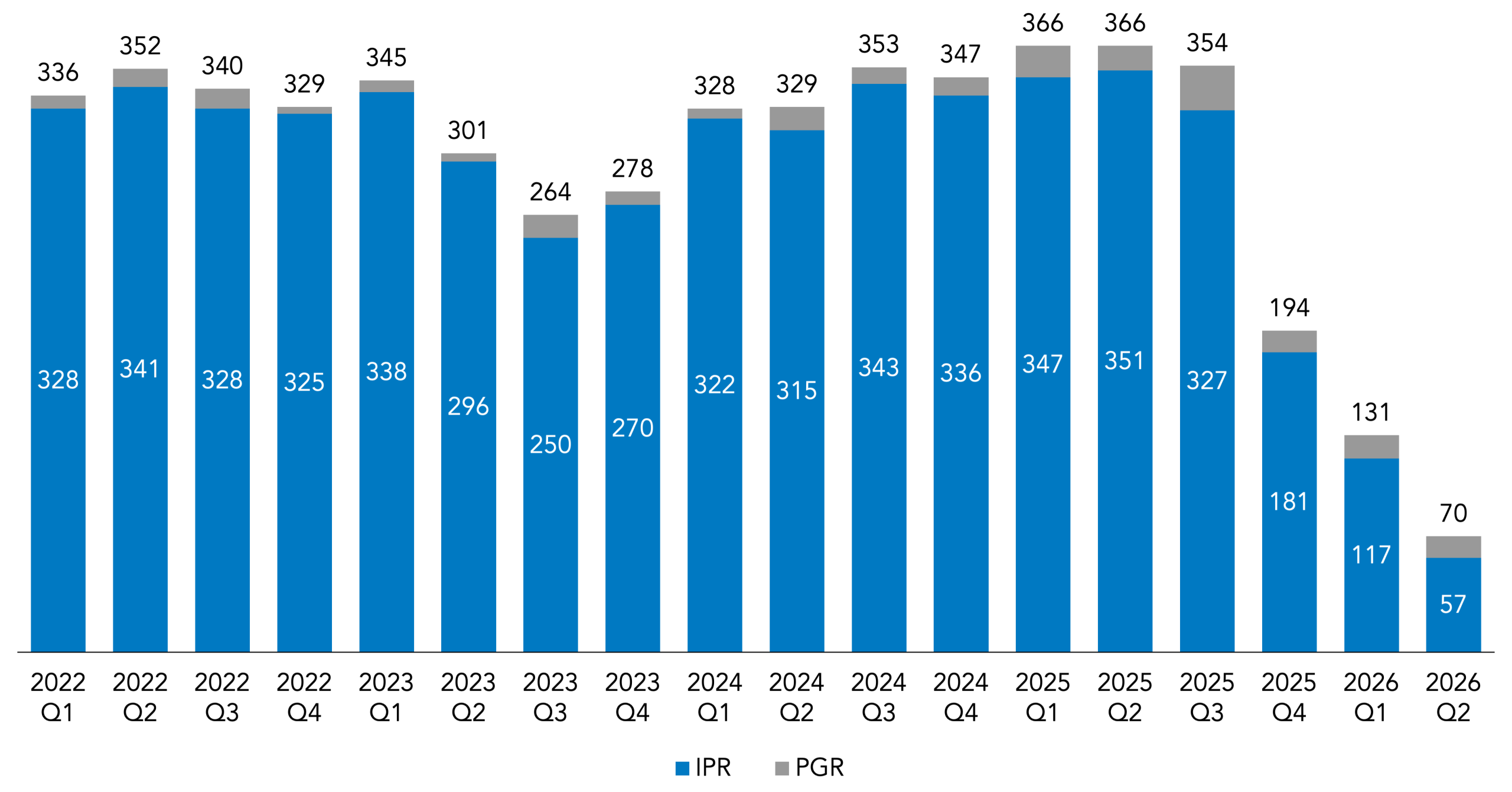
The cause of this downturn has been an ongoing series of changes at the USPTO that have significantly limited the availability of AIA reviews. Among those changes has been a revamp of the substantive and procedural standards governing institution, implemented over the course of the past year.
In March 2025, then-Acting Director Coke Morgan Stewart established an interim process under which she would decide requests for discretionary denial herself, rather than a PTAB panel doing so. Under that interim process, Stewart would make that determination by applying an expanded set of discretionary factors based on various PTAB precedents—including one factor where institution is less likely for older patents based on the “settled expectations” of the parties, and another where a petition may be denied based on a prior adjudication of validity for the challenged claims by the USPTO or another forum. The Acting Director would then refer the surviving petitions to a panel for consideration of the merits and other nondiscretionary institution factors.
Then, in October 2025, newly confirmed Director John Squires announced that he would now decide all aspects of AIA review institution himself, including discretionary considerations as well as the merits. That director-led institution procedure built upon the March 2025 interim process, superseding it to the extent that most petitions now only receive summary decisions that provide little, if any, insight into the director’s rationale for denying or granting institution; and to the extent that the nondiscretionary aspects of institution are no longer referred to panels.
The institution rate also fell dramatically over the course of 2025 as a result of these changes, and in Q4, Squires instituted trial in just 12% of the petitions that he decided under the fully director-led process. That said, the rate has since climbed: Under Squires, it rose to 26% in Q1 2026 and then to 38% in Q2.
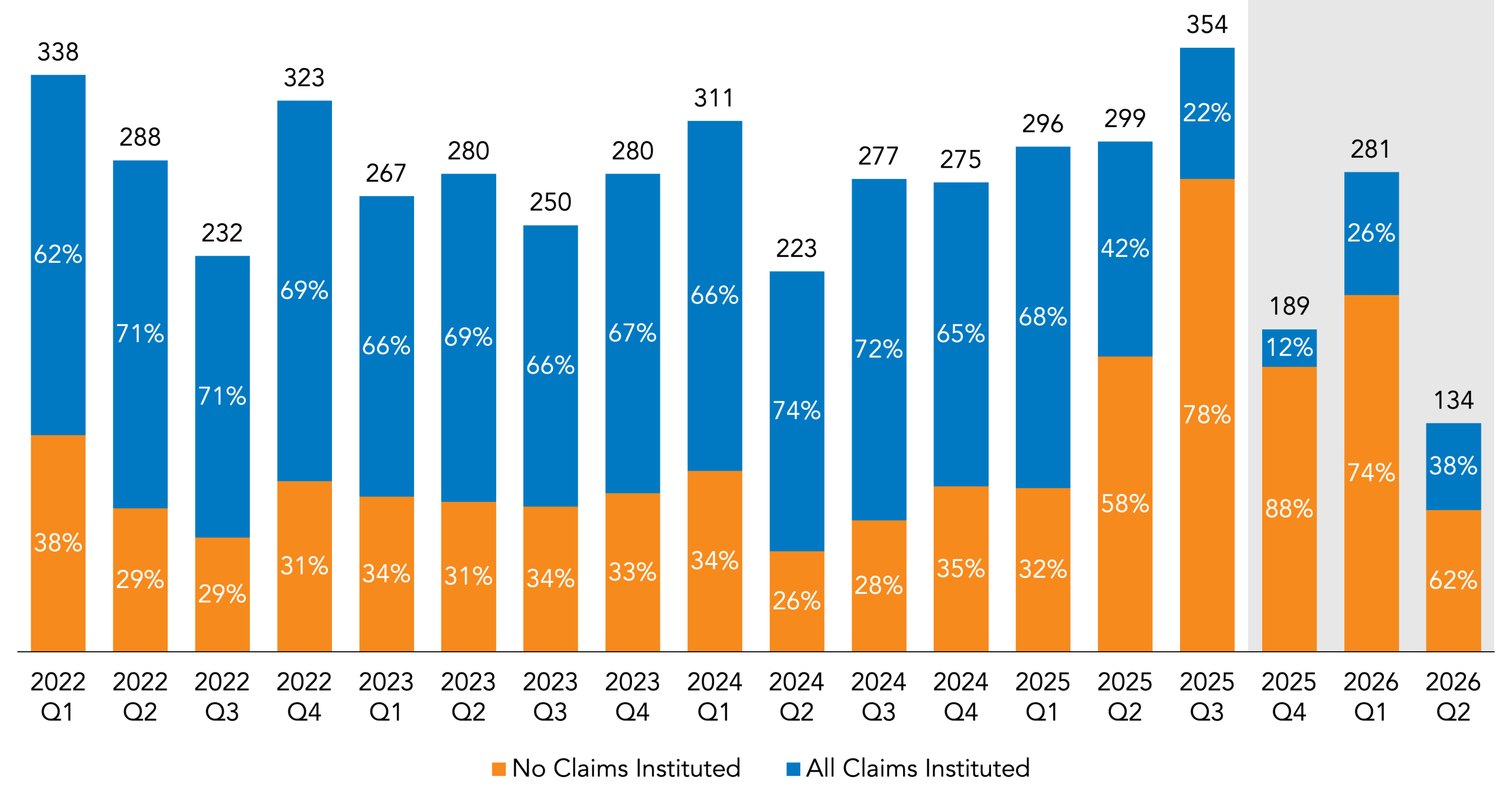
The above graph excludes institution decisions referred to PTAB panels. Including such petitions, the overall institution rate was higher at 39% in Q4, during which time a relatively larger number of referred petitions saw panel institution decisions on the merits (since, under the October process, petitions previously referred to panels would generally remain with those panels). The gap was far smaller for Q1 and Q2.
Squires Details New Discretionary Factors
While the institution process remains far more opaque than it did under the Biden Administration, given the prevalence of summary institution decisions, Squires has since pulled back the curtain somewhat: On May 14, 2026, Squires issued a precedential decision in Magnolia Medical Technologies v. Kurin (IPR2026-00097) that outlines a set of discretionary factors underpinning his current approach, one that doubles down on prior decisions limiting AIA review when there has been parallel litigation. In Magnolia Medical, the director reiterated that his approach to institution is designed to ensure that AIA review serves as an “alternative” to district court litigation, arguing that the purpose of AIA review is to promote the “public interest” rather than the narrow “interests of private litigants”.
To that end, the decision provides a set of factors that give examples of discretionary considerations falling under that public interest standard: As detailed in various recent precedential and informative decisions, the director established that he may consider examiner error, whether there have been different claim constructions offered before the PTAB versus in parallel district court proceedings (as established in an earlier precedential decision by Squires in Revvo Technologies v. Cerebrum Sensor Technologies), whether foreign sovereigns are properly disclosed as petitioners or real parties in interest (per another precedential opinion in Tianma Electronics v. LG Display), and the parties’ “settled expectations” based on the age of a patent (as noted above).
In other decisions designated as informative, Squires has also provided similar scrutiny with respect to petitioners who assert indefiniteness arguments in district court without sufficiently justifying their pursuit of different arguments before the PTAB and has rejected subsequently proposed stipulations to withdraw those inconsistent district court arguments if the petition were instituted (see Ford Motor Company v. AutoConnect Holdings, Terumo BCT v. Haemonetics, and TikTok v. Shopsee).
Yet more notable decisions have focused on divergent validity outcomes between the PTAB and district court, based on a September 2025 memorandum requiring the PTAB to adequately justify decisions that reach a different result from the other forum. Two such decisions in late June, one issued by the Director himself and the other by a Delegated Review Panel he convened, overturned final written decisions that had invalidated patents at the heart of recent infringement verdicts—casting uncertainty over millions of dollars in damages.
Squires Expands Director Review Power
Stewart and now Squires have also limited the AIA review process using their director review power. That system, as originally contemplated by the Supreme Court’s Arthrex decision, gives the USPTO Director the authority to rehear the PTAB’s final written decisions on validity but has been implemented more expansively to encompass various other aspects of PTAB proceedings, including institution decisions. While the applicable rules explicitly let parties request director review of various matters, Stewart and now Squires have broadly wielded this power sua sponte (i.e., on their own initiative, without the request of either party) to revisit prior institution decisions, in some cases de-instituting IPRs already in progress, in support of subsequently announced policies.
In late June, Squires issued another precedential decision that further expands the scope of the director review process by placing an even greater focus on parallel litigation. In Light & Wonder v. Evolution Malta, Squires extended the deadline for seeking director review and established that parties may request such review under “exceptional circumstances” when trial has “not progressed meaningfully”. Such “exceptional circumstances” include where “all or substantially all claims” have either been dismissed or invalidated in a parallel case (the one at issue here having been dismissed due to a district court ineligibility ruling under Section 101), as well as when a petitioner is alleged to have violated a Sotera stipulation (where a petitioner agrees not to raise invalidity grounds that it raised or reasonably could have raised before the PTAB in a related district court case or International Trade Commission (ITC) investigation). That last factor comes as Squires has explicitly begun to scrutinize purported Sotera violations, for instance doing so in an IPR filed against patent owner Nokia by ASUS over a violation allegedly made during a related ITC investigation.
Initial reactions to the Light & Wonder decision have framed it as significantly expanding the reach of director review by allowing the termination of IPRs that are much further along and/or as a result of validity-related developments in parallel litigation. Law firm Sterne Kessler has emphasized that as a result, “[i]nstitution is not a fixed milestone but remains subject to ongoing oversight”, thereby requiring petitioners to keep close tabs on developments in parallel litigation. Similarly, Fredrikson & Byron shareholder R. Scott Johnson has also warned in comments to IAM (see here) that petitioner-defendants “will need to be more careful to ensure that they are not engaging in activity that could be perceived as violating Sotera stipulations, and will also need to prepare to respond to petitions for director review outside of the usual timeframes”.
Another attorney, Michael Kiklis of Kiklis Law Firm, has highlighted the role of Section 101 challenges going forward, observing to IAM that the decision reinforces their value for defendants while offering patent owners a chance that an appellate outcome in their favor could foreclose further PTAB activity (albeit a small chance, given that “the Federal Circuit has been affirming the vast majority of patent ineligibility findings and reversing many patent eligibility findings”).
Stakeholders Spar over Appellate Bar
As Squires continues to impose limits on the AIA review process, the Federal Circuit has held that many of these changes are barred from review under 35 U.S.C. § 314(d), which the Supreme Court has interpreted as insulating matters that are “closely related” to AIA review institution from appeal.
The Federal Circuit has applied that appellate bar expansively; since late last year, for instance, it has rejected a variety of mandamus petitions targeting the sweeping use of discretionary denials. Those denied petitions include several challenging the application of “settled expectations” to deny review based on patent age.
In April, Google sought Supreme Court review of one such denial in an IPR against VirtaMove Corp., arguing in its certiorari petition that the USPTO has exceeded its statutory authority through that practice. Google asserts that under the Supreme Court’s Loper Bright decision, courts are not barred from reviewing the extent of an agency’s discretion. It further contends that the statutory bar does not prevent appellate review when, as it contends is the case here, the USPTO “has engaged in ‘shenanigans’ by exceeding its statutory bounds” (quoting the Court’s 2018 decision in SAS Institute v. Iancu). Seven amicus briefs have been filed in support of the petitioner by various industry organizations, scholars, and other stakeholders.
The Federal Circuit has also recently denied appeals from patent owners as barred from review: In late April, the Federal Circuit rejected an appeal challenging the PTAB’s refusal to make a real party in interest (RPI) determination (in Federal Express v. Qualcomm, as detailed further here); and in early June, it declined to consider arguments that an IPR should have been terminated due to the alleged violation of a Sotera stipulation by the proceeding’s named RPI (in Hafeman v. Google).
Reexams Continue to Climb Amid IPR Uncertainty
As the USPTO’s ongoing changes accelerate the IPR filings nosedive, would-be petitioners have instead leaned even harder into ex parte reexamination. While reexams offer no participation for requesters once initiated and tend to proceed more slowly (with an average and median time from filing to the USPTO’s issuance of a Notice of Intent to Issue a Reexamination Certificate, or NIRC, of around 15 and 11 months for USPTO fiscal year 2026, according to official data), they are not subject to discretionary denial to the same extent as AIA review—though, as noted below, recent changes could undercut that advantage.
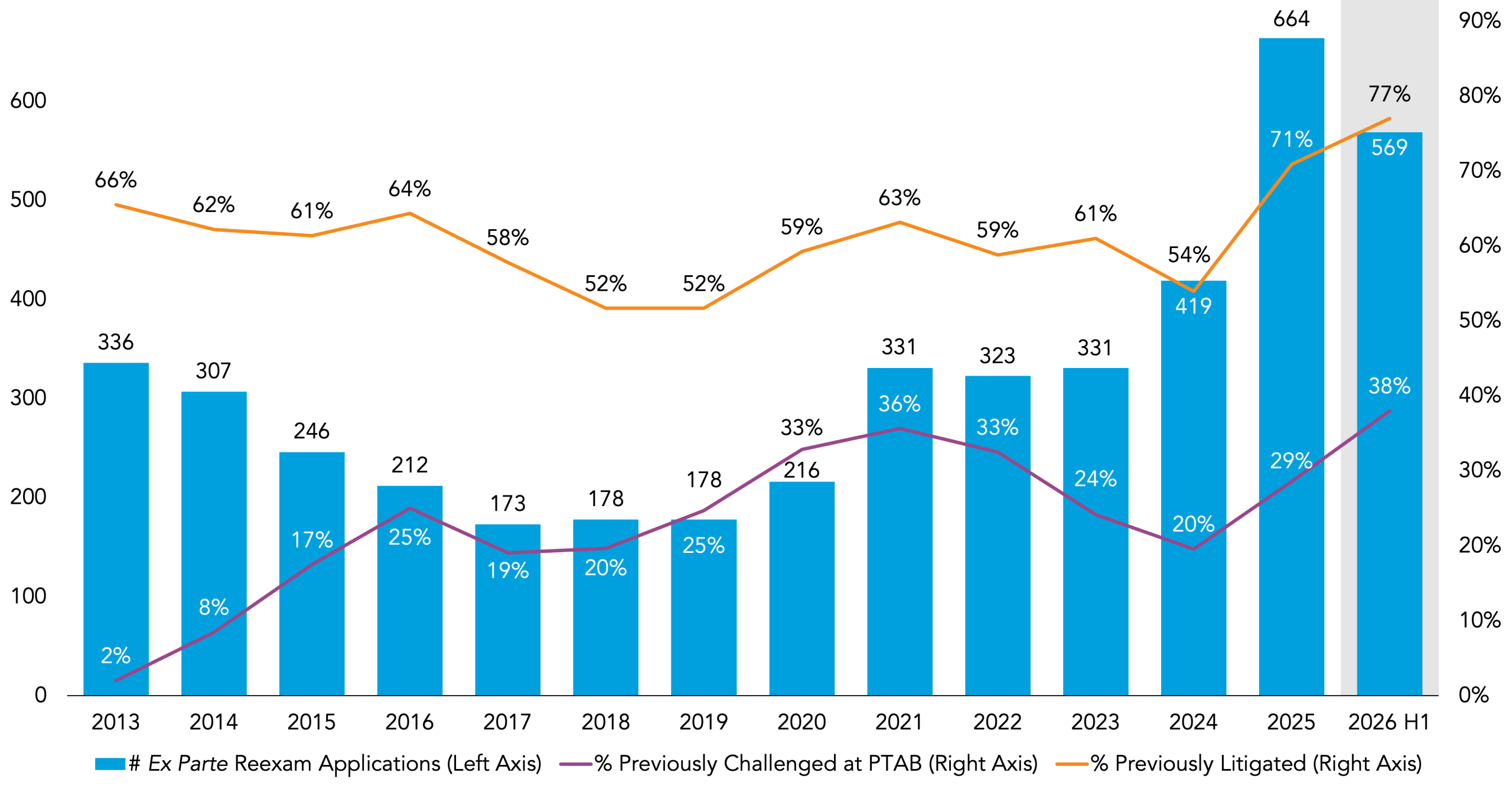
As RPX has previously noted, reexam filings have tended to climb in response to policy shifts that constrain IPR access: In 2020, the year that the Fintiv decision was designed as precedential, the number of requests for ex parte reexam increased by 21%, and then by 53% in 2021. While they held steady at about 330 requests per year in 2022 (the year Vidal issued the just-overturned guidance limiting NHK-Fintiv) and 2023, they surged by 27% in 2024 (following a decision by Vidal, in CommScope v. Dali Wireless, that limited the “compelling merits” exception then in effect under the 2022 guidance) and jumped further, by 58%, in 2025.
Reexams have climbed even higher so far this year: After 254 such requests were filed in Q1 2026, a 189% jump compared to that same quarter last year, Q2 saw 315 new filings, or 160% more than the year-ago quarter. Just halfway into the year, reexam filings are now just 14% lower than the entirety of 2025.
Data additionally indicate that the share of patents with reexam requests that have also been litigated in district court has continued to climb—reaching 77% in the first half of 2026, up from 71% in 2025 as a whole. Data also show that the number of patents for which defendants have also requested IPRs has kept rising, following a steady downward slide: After peaking at 36% in 2021 and decreasing to 33% in 2022, 24% in 2023, and 20% in 2024, this share jumped to 29% in 2025 and then to 38% in 1H 2026.
However, recent decisions indicate that reexams may no longer be quite as insulated from outcomes in other forums, thereby undercutting a key aspect of their appeal. In Q2, the USPTO began to reject requests for reexam under 35 U.S.C. § 325(d)—which allows discretionary denials of AIA reviews and reexams when the “same or substantially the same prior art or arguments previously were presented to the Office”—based on the prior discretionary denial of overlapping, parallel IPRs. Defendants may need to rethink the sequencing of their defensive strategies as a result, given the possibility that an IPR petition, even one not decided on the merits, could foreclose a potential reexam.
UPC Update: New Process for Long-Arm Jurisdiction; German Local Divisions Still Dominate
One of the most notable developments in the patent space last year was an appellate decision that significantly expanded the reach of Europe’s Unified Patent Court (UPC). While the UPC already allowed plaintiffs to seek damages and infringement spanning up to all 18 participating EU countries, that decision—issued by the Court of Justice of the European Union (CJEU) in BSH Hausgeräte v. Electrolux—confirmed that the UPC can also decide claims arising beyond those UPC territories.
BSH did so by removing a prior restriction on EU courts’ use of their existing long-arm jurisdiction: The CJEU held that a rule giving EU national courts exclusive jurisdiction over validity actions no longer requires courts in other EU countries to stay litigation over a patent when that patent has been subjected to a validity challenge in its country of issuance.
As a result, under BSH, the UPC and national courts in EU countries may now award damages and/or impose injunctions for the infringement of non-EU patents as long as the defendant is domiciled in one of the 18 countries participating in the UPC (for UPC litigation) or in the EU more broadly (for national court litigation). The decision also confirmed that the UPC lacks the authority to invalidate patents issued in non-EU countries, though (as relevant below) it may decide invalidity insomuch as it affects a given case.
Since then, the UPC has increasingly leveraged BSH to issue injunctions covering countries that are not UPC member states—beginning with the Mannheim Local Division’s (Mannheim LD’s) July 2025 decision in Fujifilm v. Kodak, which issued the UPC’s first-ever injunction covering the UK (which left the EU after Brexit).
The UPC Court of Appeal’s June 2 decision on appeal from the Mannheim LD in that case further detailed the proper application of BSH. On June 2, the Court of Appeal entered a decision that reversed the UK injunction due to the failure to properly establish infringement (also reversing a German injunction due to private prior use); confirmed that the UPC’s jurisdiction is not limited to UPC territory; and most significantly, clarified the rules for when and how the UPC should exercise long-arm jurisdiction over claims of infringement of European patents that arise in non-UPC countries.
The decision breaks down how the UPC should handle various scenarios based on where the claim arises and whether the UPC deems the patent likely invalid.
One such scenario involves patents issued in non-UPC EU countries, or in non-EU European countries belonging to the Lugano Convention (a treaty that gives its non-EU signatories similar jurisdictional protections as EU states). If the UPC deems such a patent to be infringed but invalid, the Court of Appeal held that the UPC should ask the patent owner if it wishes to withdraw the infringement action. If it decides not to do so, the UPC shall then allow the defendant to file national revocation actions in the applicable EU/non-Lugano countries, and should generally stay the long-arm case in the meantime. However, if the defendant does not file those validity challenges within an “appropriate period of time”, the UPC will then presume the patent is valid in the EU/Lugano country and decide the case accordingly.
Another scenario involves claims asserting a patent issued in a non-EU or non-Lugano country. When the UPC considers such a patent infringed but invalid, the Court of Appeal generally requires the court to dismiss the case if the patent owner decides not to withdraw it unless there is a reason not to (such as when an extraterritorial patent claim is different and may be valid).
The last scenario involves both EU/Lugano and non-EU/Lugano patents that are considered both infringed and valid. When the UPC determines there is a “reasonable, non-negligible possibility” that a national court would hold the patent to be valid, the UPC may attach a condition subsequent to its decision based on whether the patent is wholly or partially invalidated.
If a national court does issue such a decision upholding validity, the injunction becomes permanent once the decision is final. However, if a national court wholly or partially invalidates the patent to the extent that it undercuts infringement, either via a first-instance or appeal decision, then the UPC’s injunction “falls away”. If that happens, the patentee can request a stay of the UPC long-arm case until the national court’s invalidity decision becomes final.
Data Update: Filings on the Rise as Practitioners Scrutinize Heavy Concentration in German Divisions
The UPC’s continued popularity, due in part to the sweeping relief it offers plaintiffs, is reflected in its growing year-over-year infringement caseload: The court’s recently published annual report for 2025 shows that 266 infringement cases were filed in 2025, marking a 62% increase compared to 2024 (which saw 164 such cases). That said, the court saw 102 new infringement cases in the first half of 2026 (according to the UPC’s latest monthly data update), or slightly less than in 1H 2025 (which saw 111 new cases during that time).
Infringement litigation also remains heavily concentrated in the four German local divisions, albeit somewhat less so in 2026 thus far: While those local divisions accounted for 77% of the infringement cases filed in 2025, that share has fallen to 69% in the first half of 2026.
A recent survey of patent practitioners in Europe, conducted by the European Patent Lawyers Association (EPLAW) of its own membership and sent to the UPC Advisory Committee in early April, provides some insights into the reason behind this concentration of filings. (The letter, widely published but not separately released by EPLAW, can be found here.) The letter observes in part that this distribution represents a continuation of the pre-UPC trend, since German national courts historically saw the most such cases prior to the UPC. The letter also suggests that familiarity with the German system and practices, strong relationships with German counsel, and the perception of German judges as especially experienced and engaged/invested in the UPC’s success have further contributed.
However, EPLAW also reports that its membership is evenly split on whether the current case distribution is problematic, with German respondents (representing about 50%) predictably seeing no issues with the current system and suggesting that rules enabling choice of forum remain unchanged. Non-German respondents acknowledged the choice of forum argument but favored change, expressing concern that the current rules are “undermining the UPC’s pan-European character”, limiting the judicial diversity of the first-instance court, slowing the ability of other local divisions to build capacity, and “weakening political support among UPC member states and potential future joiners”. A variety of potential short-term, non-legislative solutions are also discussed, including to offer transfers due to backlog-related delays, ensure that all local divisions adopt similar practices to ensure “predictability and efficiency”, and make changes related to judge allocation and rotation; as well as other proposals that would require amendments to the UPC Agreement.
NPEs at the UPC
The past few months also saw several new NPE lawsuits filed at the UPC, including litigants linked to notable monetization professionals from both sides of the pond.
Among those plaintiffs are three linked to SIM IP—a new monetization firm cofounded by CEO Erich Spangenberg, the principal of early US assertion outfit IP Navigation Group, LLC (d/b/a IPNav). On May 28, SIM IP subsidiary Qord IP Protection LLC (f/k/a SIM IP 4 LLC) filed a suit against Samsung and subsidiary SmartThings at the UPC’s Hague Local Division. SIM IP confirmed to IP Fray that Qord IP has also filed a parallel suit at the Munich I Regional Court, collectively characterizing the litigation as targeting the SmartThings platform. At issue are patents that SIM IP acquired in October 2025 from Australian data exchange platform Qord IP.
Then, in early July, NIXU FL IP Protection LLC—another SIM IP subsidiary—reportedly filed suit against Amazon Web Services at the UPC’s Milan Local Division, seeking “pan-UPC” relief according to IP Fray. The case follows NIXU FL IP’s first UPC suit, filed in January 2026 at the Hamburg Local Division. Both assert patents from a portfolio that SIM IP acquired from FusionLayer (f/k/a Nixu Software) last year as part of a partnership with the patents’ former owner, as described in a joint announcement.
SIM IP appears to view the UPC as central to its enforcement strategy: In a January 2026 letter to its shareholders, Spangenberg and David Kutcher, the latter SIM IP’s CFO and cofounder, characterized the UPC as “the most efficient, cost-effective, and predictable forum globally for enforcing and monetizing IP rights”. Spangenberg has also characterized the UPC as “[o]ne thing the EU got right” due to its relative speed, lower cost, and high injunction rate, urging the US to follow suit by passing the RESTORE Act (a bill to roll back the Supreme Court’s eBay decision, which essentially eliminated automatic injunctions in favor of a four-part equitable test).
Also bringing a new round of UPC litigation were ParTec AG and its coplaintiff and “licensing agent” BF exaQC AG, which filed a trio of suits over patents related to high-performance computing: a May 22 case against Lenovo in the Düsseldorf Local Division; a June 3 case against AMD and Bull in the Mannheim Local Division (Mannheim LD); and a June 11 case against Google, also in the Mannheim LD. The CEO of ParTec is inventor Bernhard Frohwitter, the same individual behind notable German NPE IPCom Gmbh & Co KG.
FRAND Update: Courts Issue Dueling Global License Decision; SEP Arbitration on the Rise
Parallel SEP Decisions Underscore Key Venues’ Divergent Approaches to FRAND Licensing
Since national courts began asserting the power to set the terms of global fair, reasonable, and nondiscriminatory (FRAND) licenses, standard essential patent (SEP) litigation has been an international affair: Such disputes now typically involve competing parallel cases spread among the world’s top SEP venues, as parties file where they perceive the greatest potential advantage.
Despite the prevalence of such parallel litigation, no dispute had previously seen two courts in different jurisdictions issue competing global FRAND determinations—until now.
Toward the end of the second quarter, litigation between ZTE and Samsung over the renewal of an expired cross-license culminated in a set of FRAND opinions from courts in four separate jurisdictions, including two full FRAND determinations from courts in the UK and China as well as opinions of a more advisory nature from a German court and the Unified Patent Court (UPC).
Those first two decisions both came on May 1: One from the UK High Court, where Samsung, here the net licensee, filed a FRAND determination case and undertook to accept the terms set by the court; and the other from the Chongqing Intermediate People’s Court, where ZTE sought a determination that its offer had been FRAND. ZTE did not undertake to accept the UK determination.
The UK Decision
The UK decision focused mainly on comparable licensees. Samsung had argued that the court should rely upon its 2021 cross-license with ZTE and a 2020 license between ZTE and Apple. ZTE, in contrast, urged the court to rely on Samsung’s 5G licenses with Ericsson, Nokia, and InterDigital, Inc. (collectively addressed as “ENI”). Justice Richard Meade, writing for the court, sided with Samsung and relied upon its suggested licenses: He agreed that the ENI licenses were “so different” from ZTE’s, even after accounting for size, due to the ENI licensors’ experience with out-licensing and their willingness to litigate.
However, Justice Meade adjusted upward from Samsung’s proposed $200M license (covering five years) to account for non-FRAND factors, including the financial impact of US sanctions on ZTE and its “minimal experience in out-licensing” (per the court), as well as the relatively lower value ascribed to its 5G patents in the 2021 license with Samsung. The court rejected ZTE’s proposed top-down cross-check (under which, as a general matter, the relative value of a specific SEP portfolio is apportioned based on the aggregate royalty that would be paid for all SEPs covering the applicable standard) and instead performed its own upward adjustments, by 12.5% to the Apple license because it had been ZTE’s “first out-license” and by 5% for that license to account for the value of ZTE’s 5G patents. The court also adjusted for the fact that Samsung had paid a premium (not publicly disclosed) in the 2021 cross-license in exchange for a covenant not to sue (CNS) that the court found to have released Samsung from liability for 2024.
Ultimately, the UK court arrived at a $392M lump sum for a five-year cross-license, still far closer to the $200M amount for five years sought by Samsung than to the $731M sought by ZTE (for a six-year license). Law firm Cleary Gottlieb has commented that because Samsung was the net licensee and ZTE had not undertaken to accept the UK determination, this rendered the decision “strictly declaratory”.
The Chinese Decision
In contrast, the Chongqing court reportedly found that ZTE’s $731M offer was FRAND. IAM has observed that this appears to be the first time that “a court (Chinese or English) has accepted that a net licensor’s offer is FRAND in a global rate-setting decision”. The court also reportedly used a comparable license approach to set the rate for the parties’ 2G-4G patents, relying on their 2021 agreement; but used both ZTE’s proposed top-down cross-check and the ENI agreements as comparables to set the 5G rate—approaches rejected by the UK court, as noted above. Another distinction is that the Chongqing court found that the CNS did not release Samsung from liability for 2024, instead holding that royalties for 2024 were to be folded into the lump sum for a 2025-2029 license. The court’s ruling does not become binding unless the court determines infringement by Samsung in parallel, upcoming technical trials, and potentially not until after any resulting appeal(s).
Exactly how those two courts will treat each other’s decisions remains to be seen. The UK court noted this issue in its decision—acknowledging, but not deciding, the parties’ dispute over whether the latter ruling could give rise to res judicata in the UK, or whether and to what extent the Chinese judgment could bind the UK court.
The German Decision
Yet another ruling came in Germany, where courts have typically taken a different approach to FRAND issues: They view FRAND compliance as a matter of competition law under Huawei v. ZTE; have, under that framework, focused on the parties’ conduct during negotiations as key in establishing their compliance with their respective FRAND negotiations; and have held that that a range of license offers may be FRAND, rather than trying to identify a single set of terms. Perhaps most notably, German courts have avoided engaging in rate-setting and have tended to use injunctions to push parties toward settlement.
The Munich I Regional Court’s May 13 decision in ZTE v. Samsung was something of an outlier in that the court did in fact engage in a hypothetical global rate-setting exercise, doing so without the request of the parties. That said, in doing so, the court explicitly rejected the notion that it should actually set a global FRAND rate and instead did so to determine where the parties’ offers fell within the FRAND range. In that analysis, the court identified no reliable comparable agreements: It rejected the 2020 ZTE-Apple license and the 2021 ZTE-Samsung license due to the aforementioned issues with ZTE’s licensing experience and sanction-related economic conditions; declined to rely upon a set of 2024 agreements between ZTE and each of Oppo, Vivo, and Xiaomi because all sets of parties were Chinese, due to the country’s “socialist market economy in which the state exercises considerable influence”; and did not consider the ENI agreements at all.
Rather, the German court used a top-down approach, identifying an aggregate royalty burden of 8%, yielding a total $13.70 rate per Samsung device that it then scaled down to a $0.7752 per-unit rate to account for ZTE’s share of the relevant standards. After applying that rate to Samsung’s projected sales for the license’s five-year term, discounting by 30% due to Samsung’s size but adding 10% due to its conduct during negotiations (for a net discount of 20%), and subtracting $134M for ZTE’s use of Samsung patents, the court arrived at a midpoint amount of approximately $726M. Adjusting upward by 10% to account for the fact that negotiations had not yet concluded, the court then arrived at $799M as the upward limit for the “FRAND corridor” of permissible rates. As a result, the court found that since ZTE’s $731M offer is below that limit, that offer is FRAND.
The Munich court further held that in the event it were to make a global FRAND determination, it would set a rate of $640M for a five-year license, reflecting a deduction of $107.3M for the cross-license to Samsung’s portfolio (a value set by applying the aforementioned 20% net discount to the $134M figure mentioned above).
The UPC Decision
Then, in a parallel action before the UPC’s Mannheim Local Division, the court issued the UPC’s first-ever license rate settlement recommendation. In a four-page order issued on May 13, the court briefly acknowledged the above three decisions before making two alternative proposals. The first recommended a cross-license under terms described within a February 26 judgment by the Frankfurt Regional Court in a parallel antitrust case, and a $640M “lump sum balancing payment” to ZTE for a license extending through 2028 (i.e., the same amount as the Munich decision). The second recommended a cross-license under terms specified in another filing (this one not identified in the document), with a $730M lump sum balancing payment to ZTE (just shy of the amount set by the Chongqing court).
UK Court of Appeal: Arbitration Offers Can Be RAND
Another significant SEP development in Q2 was an important UK appellate ruling that could encourage the use of arbitration to resolve such disputes. The judgment overturns a UK High Court decision from late last year that had adopted a relatively restrictive view of the interplay between arbitration and RAND compliance.
The overturned decision came as part of a larger ruling on claims for an interim license declaration filed by implementers Acer, ASUS, and Hisense against SEP owner Nokia. Nokia had made a set of “Adjustable Arbitration Offers” that offered “adjustable RAND licenses” mostly similar to the interim license declarations sought by the implementer claimants but that differed mainly in that an arbitrator would resolve the underlying issues, with the arbitrator given similarly broad powers to resolve the dispute and with Nokia taking similar positions on mutual disclosure of comparable licenses and confidentiality. (The distinction between RAND and FRAND did not affect the outcome in this case.) Nokia argued that the Adjustable Arbitration Offers themselves constituted RAND offers that satisfied its RAND obligation, and that the claimants had to accept these offers to comply with their own RAND obligations.
In a December 18, 2025 order, Justice James Mellor disagreed, rejecting an underlying jurisdictional challenge from Nokia—ruling that the arbitration offers do not constitute a RAND offer capable of acceptance. The court determined instead that each is just an offer to enter into arbitration, and that only after such arbitration occurs would there be a RAND offer that can be accepted. Moreover, the court observed that even if the Adjustable Arbitration Offers did constitute a RAND offer, the implementer claimants’ undertaking to accept the UK court’s final and interim FRAND terms would also render them willing licensees. Additionally, the court treated consent as paramount, holding that arbitration is not a proper “alternative forum” in the absence of an arbitration agreement between the parties, and that the proposed arbitration is not clearly a more appropriate forum than the UK. As a result, the court declined a case management stay.
However, the UK Court of Appeal rejected that view in a unanimous decision issued on May 12, 2026, authored by Lord Justice Richard Arnold. The court held that because Nokia’s proposal would result in the arbitration tribunal making a RAND determination, and because Nokia has offered a license on whatever terms will be set by the arbitrator, it has offered a license on terms that are “objectively RAND”—thus determining that Nokia had complied with its RAND obligation through its arbitration offer.
The Court of Appeal further ruled that while the implementers may not be compelled to arbitrate, their only other choice under the circumstances is to refuse the offer. Since that means they are rejecting a RAND offer, the court held, they may no longer seek a RAND determination from a UK court, since their jurisdiction depends on the implementer’s willingness to take a RAND license. The court agreed with Nokia that “a SEP owner is entitled in each case to choose the forum which it considers best suits its interests”, though it acknowledged the need not to encourage forum shopping. Additionally, the court held that under this principle, Nokia could make arbitration offers in this case while accepting the jurisdiction of the UK court in other litigation brought by Warner Bros. and Paramount.
Having determined that under this holding the implementers’ RAND determination claims “have no real prospect of success”, the court then granted Nokia’s request for a permanent case management stay.
In a follow-up decision issued on May 18, the Court of Appeal further established that Nokia could not include in its arbitration offer a disputed requirement that arbitration cover a broader cross-license to the implementers’ own patents. The court held that such a requirement would not be RAND, in part holding that this flows from Nokia’s own argument that the patent owner may choose between arbitration and court proceedings when seeking a (F)RAND determination.
Since then, multiple SEP cases have ended with agreements to determine final (F)RAND terms through arbitration. Among them is the above litigation: On June 22, Nokia announced settlement agreements with both Acer and ASUS, the parties in both cases agreeing to determine the license terms through arbitration.
Additionally, Amazon and InterDigital—both engaged in another sweeping, multijurisdictional SEP dispute—apparently notified the High Court earlier in June that they had agreed to arbitration. That said, the parties have since publicly sparred over the proper characterization of that agreement: In part, Amazon has argued that InterDigital was wrong to describe their agreement as a “patent license agreement” and as having already “resolve[d] all pending litigation”, while InterDigital has countered that a resolution of all litigation is the “unavoidable result of that agreement to arbitrate and resulting license”.
US Policy Update: Litigation Funding, Foreign Adversaries, and the US Patent System
State and Federal Scrutiny of TPLF Continues to Intensify
Momentum for third-party litigation funding (TPLF) disclosure and regulation continues to build across state legislatures and all three branches of the federal government. Over a dozen states to date have enacted laws addressing litigation funding, and in 2025 alone, more than 20 states introduced TPLF-related legislation. Most TPLF statutes focus on commercial (not consumer) litigation finance and require disclosure of funding arrangements, transparency regarding foreign or sovereign wealth involvement, or restrictions on investments by foreign litigation funders.
The movement gained additional traction at the end of the second quarter when North Carolina became the first state to broadly prohibit third-party litigation funding. Under the state’s Prohibit Litigation Investment Act, it is now unlawful for any person or entity to engage in litigation investment in North Carolina or to provide litigation funding to a party or counsel of record in a civil proceeding within the state.
Although these state laws may not individually have a significant impact on patent litigation, their cumulative effect could shape federal policy discussions surrounding TPLF. For example, some commentators (e.g., here) have suggested that courts’ historical reluctance to require disclosure of litigation funding arrangements has been driven, at least in part, by concerns around confidentiality and preserving access to justice. However, those concerns may carry less weight, as more states adopt disclosure requirements and other regulations governing litigation funding. Eventually, mandatory disclosure may be viewed less as a barrier to access and more as a transparency measure in alignment with an emerging regulatory framework.
Indeed, some courts have begun requiring disclosure of litigation funding arrangements, and in late 2024 the Judicial Conference’s Civil Rules Advisory Committee established a subcommittee to evaluate whether a uniform disclosure rule should be adopted. The Committee is scheduled to meet again this fall; however, even if a proposal to amend Rule 26(a)(1)(A) is advanced this year, any final rule would likely still be years away under the Rules Enabling Act process.
Other developments are moving forward on parallel tracks. In January, the US Court of International Trade amended its corporate disclosure requirements to include information about TPLF arrangements. Then, in April, the International Trade Commission proposed amendments to 19 C.F.R. Part 210 that would require parties in Section 337 investigations to disclose entities with financial or ownership interests in the proceeding, including TPLF funders. Public comments on the proposal closed at the end of June.
New Patent Bills Address National Security Concerns
Congress has also intensified its focus on TPLF, with lawmakers advancing multiple legislative proposals over the past year centered largely on concerns related to foreign funding and national security. Two patent bills introduced in June share that throughline: The Prohibiting Adversarial Patents Act of 2026 (H.R. 9142) is a bill introduced in June by Reps. Scott Fitzgerald (R-WI), Darrell Issa (R-CA), and House Select Committee on China Chairman John Moolenaar (R-MI). The bill aims to prevent certain foreign entities deemed national-security threats from obtaining or enforcing US patents. Its companion bill, the Foreign Adversary Patent Disclosure Act (H.R.9143), seeks to require patent applicants to disclose certain ties to designated foreign adversaries when filing patent applications with the USPTO. The RPX member-exclusive webinar covering highlights from this Q2 in Review post takes a close look at these two bills as well as TPLF legislation.
Patent Market Update: Institutional Investors Show a Continued Interest in Patent Litigation; Notable Transactions Made Public in Q2
According to Westfleet Advisors’ March 2026 annual report, capital commitments to new litigation finance deals increased approximately 23% in 2025 compared with 2024, marking a recovery after two consecutive years of decline. However, Westfleet noted that the rebound was not driven by a broad influx of new capital, as in prior expansion cycles; instead, it reflected increased deployment by a relatively small group of established funders. As a result, the market remains constrained, with many participants continuing to face fundraising challenges.
While Westfleet’s report does not address why some allocators may be hesitant to invest in litigation finance, potential factors include the asset class’s time to return, the likelihood of appeals, and the prospect of increased regulatory scrutiny. Such capital constraints are likely to be felt more acutely by standalone litigation finance firms than by institutional investors—unlike dedicated funders, institutional investors typically maintain more diversified portfolios and may therefore have a higher tolerance for risk. This may explain what appears to be a growing interest in patent litigation among institutional investors.
Q2 saw multiple plaintiffs tied to hedge funds launch new patent litigation campaigns (see here and here). Also during the quarter, RPX flagged the recording of multiple security agreements between patent holders and what appears to be a funding vehicle, signaling formation of yet another “sixpack” of plaintiffs backed by institutional investors.
Notable Transactions Made Public in Q2
As of April, the USPTO appeared to have resumed the delivery of bulk assignment data, some of it revealing transfers going back to 2025 that would appear to increase patent assertion risk. Interesting assignments made public during Q2 included some involving Dominion Harbor Enterprises, LLC (see here and here); Sauvegarder Investment Group, Inc. (d/b/a SIM IP) (here and here); the litigation finance firm Certum Group (here); and Empire IP LLC (here).
Additional RPX Patent Market Intelligence
Visit RPX Empower for further analysis and up-to-date information on patent litigation and market trends.